RTP vs Volatility: Key Differences
RTP vs Volatility: Key Differences
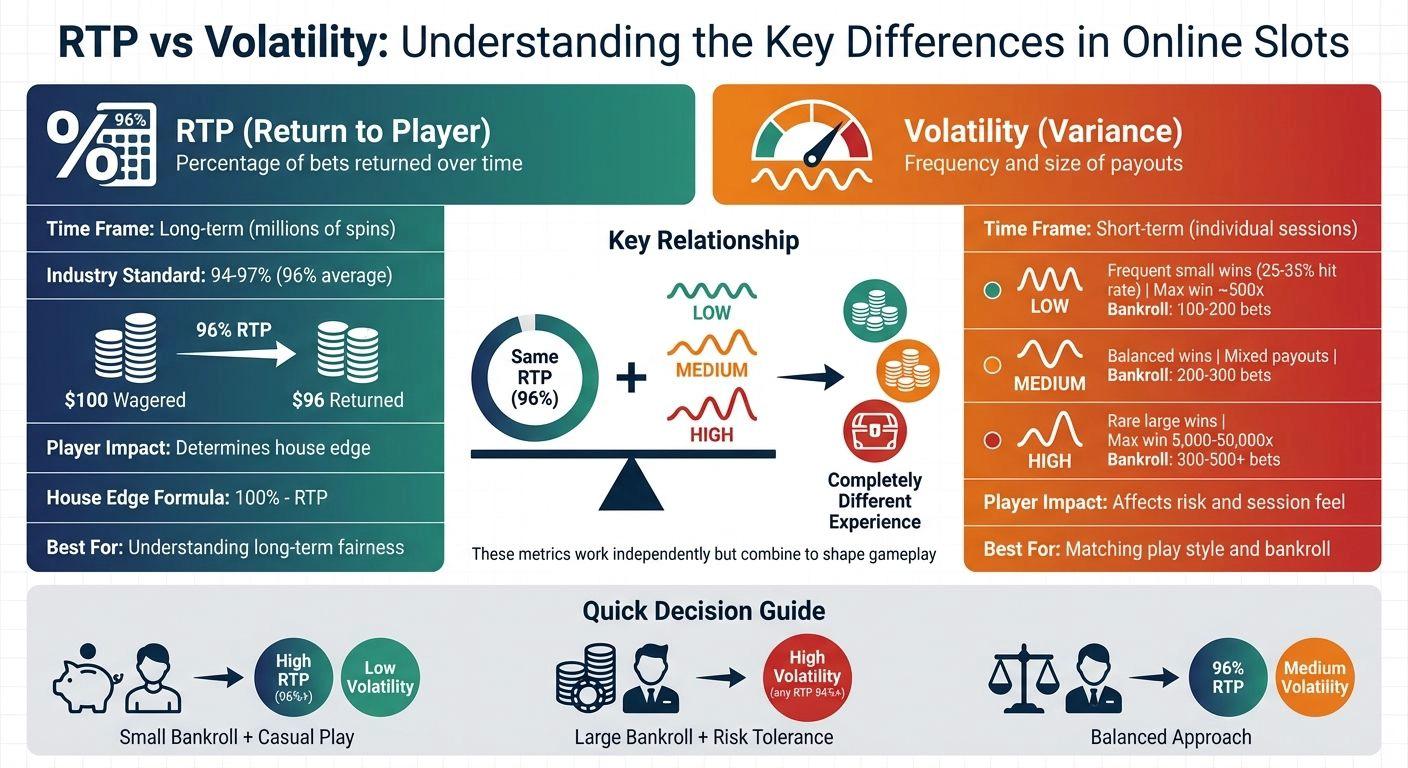
When playing online slots, two key factors can shape your experience: RTP (Return to Player) and volatility. RTP indicates the percentage of total bets a slot will return to players over time - typically around 96%. Volatility, on the other hand, explains how often and how much a slot pays out, ranging from frequent small wins (low volatility) to rare, large payouts (high volatility).
Here’s the breakdown:
- RTP is about long-term returns. A 96% RTP means $96 is returned for every $100 wagered over millions of spins.
- Volatility determines short-term risk. Low volatility means frequent but smaller wins, while high volatility offers rare but larger payouts.
These metrics don’t affect each other directly, but they combine to influence gameplay. For example, two slots with the same RTP can feel very different based on their volatility. Understanding these concepts helps you choose games that suit your budget and risk tolerance.
Quick Comparison Table:
| Feature | RTP | Volatility |
|---|---|---|
| Definition | Percentage of bets returned over time | Frequency and size of payouts |
| Time Frame | Long-term (millions of spins) | Short-term (individual sessions) |
| Player Impact | Determines house edge | Affects risk and session feel |
| Example | 96% RTP = $96 returned per $100 wagered | High volatility = rare big wins |
RTP vs Volatility in Online Slots: Complete Comparison Guide
What are RTP and Volatility in online slots?
What is RTP (Return to Player)?
RTP, or Return to Player, is the percentage of all wagered money that a slot machine is programmed to pay back to players over time. For instance, if a game has an RTP of 96%, it means that, on average, players will collectively receive $96 in winnings for every $100 wagered, while the remaining $4 represents the casino's profit.
It's important to note that RTP reflects long-term averages across millions of spins. Individual gaming sessions can vary significantly because each spin is independent, determined by a Random Number Generator (RNG). In short, past spins have no effect on future outcomes.
How RTP is Calculated
The math behind RTP is relatively simple. Imagine a slot machine that pays out $100,000 in winnings after receiving $110,000 in total bets during a specific period. The RTP would be calculated as:
$100,000 ÷ $110,000 = 90.9%.
Game developers simulate millions of spins to determine a slot's RTP accurately. Most online slots fall within an RTP range of 94%–97%, with 96% being the industry standard. Slots with RTPs of 96% or higher are considered better for players, and some games even exceed 98%. Additionally, online slots generally offer higher RTPs compared to land-based machines, which often fall between 85% and 95% due to higher operational costs.
RTP and the House Edge
RTP and house edge are two sides of the same coin. While RTP shows the percentage returned to players, the house edge represents the casino's profit margin. The formula is straightforward:
House Edge = 100% − RTP.
For example, if a game has a 96% RTP, the house edge is 4%. This means the casino keeps $4 for every $100 wagered. A higher RTP, like 98%, reduces the house edge to just 2%, giving players a better chance to maintain their bankroll during extended play.
Even small differences in RTP can have a big impact over time. For instance, if you play a slot with a 96% RTP instead of one with 94%, and you wager $2 per spin over 10,000 spins, you could save about $400.
Next, let’s explore how volatility shapes slot gameplay.
What is Volatility?
Volatility, also referred to as variance, measures the level of risk in a slot game - essentially, how often and how much it pays out. While RTP (Return to Player) tells you the average return over millions of spins, volatility explains how those payouts are distributed during gameplay. Think of it as the game's "rhythm": consistent, smaller wins versus rare, massive payouts.
"If RTP tells you how much a slot pays back in the long run, volatility tells you how it pays it back."
Volatility determines both the frequency of wins and the size of payouts. For example, two games might have the same 96% RTP but feel entirely different. One might offer small wins on 3 out of 10 spins, while the other pays out less frequently - say, 2 out of 10 spins - but with prizes that could be worth 200x your bet or more.
Low, Medium, and High Volatility Explained
Slots are generally classified into three volatility levels, each providing a unique gameplay experience:
- Low volatility slots produce frequent wins, but the payouts are usually small - often less than your original wager. These games typically have a hit rate of 25% to 35%, meaning roughly 3 out of 10 spins result in a win. A good example is Starburst by NetEnt, known for its steady stream of modest payouts.
- Medium volatility games offer a balance between frequent smaller wins and occasional larger payouts.
- High volatility slots are characterized by infrequent wins and long dry spells, but when a payout hits, it’s often substantial. These games tend to concentrate value in bonus features or jackpots. For instance, Book of Dead by Play'n GO relies heavily on its free spins feature with expanding symbols, while Gates of Olympus by Pragmatic Play delivers payouts through tumble sequences and multipliers.
| Volatility Level | Win Frequency | Win Size | Risk Level | Best For |
|---|---|---|---|---|
| Low | High (Frequent) | Small | Low | Casual players, small bankrolls, long sessions |
| Medium | Moderate | Mixed | Medium | Players seeking a balance of excitement and stability |
| High | Low (Rare) | Large | High | Risk-takers, large bankrolls, jackpot hunters |
How Volatility Affects Gameplay
Volatility plays a major role in shaping your experience and managing your bankroll. For low or medium volatility slots, budgeting for 200–300 spins is often sufficient, while high-volatility games may require 400–500 spins to weather the dry spells.
"High volatility: bankroll for droughts; expect occasional big jumps. Low volatility: smoother progress, smaller peaks."
Your bet size should also align with the game's volatility. On high-volatility slots, keeping your stakes low can help stretch your bankroll while waiting for those rare, massive payouts. On the other hand, slightly higher bets may be more sustainable on low-volatility games, where wins are more frequent.
A quick way to estimate volatility is by examining the paytable. If there’s a wide gap between the smallest and largest payouts, the game likely leans toward high volatility. Additionally, games advertising payouts as high as 50,000x your bet are typically extremely volatile. In such cases, a significant portion of the RTP is allocated to these rare, massive wins, leaving the base game with fewer frequent payouts.
Up next, we’ll dive deeper into the relationship between RTP and volatility to better understand how these metrics influence your gameplay.
Key Differences Between RTP and Volatility
RTP (Return to Player) represents the percentage of wagered money returned to players over a long period, while volatility describes the risk and payout patterns during individual gaming sessions.
These two factors work independently. For instance, a slot with a 96% RTP can have low, medium, or high volatility. This means a game with a high RTP might offer frequent small wins or occasional massive payouts, depending on its volatility. The RTP percentage stays the same, but how and when payouts occur will vary.
The main distinction lies in their time frames: RTP is measured over millions of spins, reflecting long-term outcomes, while volatility focuses on short-term win/loss patterns.
This difference also plays a role in managing your bankroll. RTP gives insight into the game's fairness over time, while volatility determines how unpredictable a session might feel. High-volatility games often require a larger bankroll to weather potential dry spells (sometimes 400–500 spins before hitting a bonus), whereas low-volatility games tend to offer more consistent, smaller wins.
RTP vs Volatility: Comparison Table
Here’s a quick comparison of these two metrics:
| Feature | RTP (Return to Player) | Volatility (Variance) |
|---|---|---|
| Definition | The theoretical percentage of wagered money returned to players over time. | Describes the frequency and size of payouts - the game's risk level. |
| Time Frame | Long-term (calculated over millions or billions of spins). | Short-term (reflecting the session's win/loss pattern). |
| Player Impact | Indicates the house edge and overall fairness. | Affects the game's rhythm and bankroll requirements. |
| Gameplay Goal | Maximizing returns in the long run. | Choosing between steady small wins or chasing big jackpots. |
| Example | A 96% RTP means $96 is returned for every $100 wagered over time. | High volatility may result in long dry spells followed by big wins. |
Up next, we’ll dive into how these metrics influence your gameplay strategy on Windice.
How RTP and Volatility Impact Your Gameplay
RTP (Return to Player) sets the stage for your long-term returns, while volatility shapes the risk and reward dynamics of each session. Think of RTP as the theoretical percentage a game returns to players over millions of spins, while volatility determines how those returns are distributed - whether through frequent small wins or rare, massive payouts.
For example, high max win games - like those offering 50,000× your stake - often come with higher volatility. Why? A significant portion of the RTP is reserved for those rare, jaw-dropping payouts, which means the base game might feel "drier" as it saves up for those big moments. Similarly, features like bonus buys, multipliers, and progressive jackpots shift the focus from regular wins to fewer, high-value events. Even if the RTP stays the same, these features crank up the volatility.
"RTP is a long-run average, not a prediction for tonight." – SlotDecoded
Hit rate, another important metric, tells you how often a game pays out. For instance, a 30% hit rate means you can expect a win roughly once every three spins. However, in high volatility games, hit rates often drop below 15% because the payout budget is reserved for those rare, big wins. Beware of "Losses Disguised as Wins" (LDWs) - those moments when the game celebrates a payout smaller than your original bet (e.g., winning $0.40 on a $1.00 spin). While they might look exciting, they can quietly chip away at your bankroll. Always keep an eye on your actual net balance rather than relying on flashy animations.
Managing Your Bankroll Based on Volatility
On platforms like Windice, matching your bankroll to the game’s volatility is crucial for staying in the game. For low or medium volatility games, plan for 200–300 spins. High volatility slots, however, may need a cushion of 400–500+ spins to ride out the inevitable dry spells before triggering a bonus feature.
Here’s a simple budgeting formula:
Spins × Stake = Session Budget.
For instance, if you’re playing a high volatility slot at $1.00 per spin, aim to set aside $400–$500. If your bankroll is tight, lower your stake rather than cutting down on the number of spins.
Here’s how volatility impacts your bankroll needs:
| Volatility Level | Win Frequency | Max Win | Recommended Bankroll | Best For |
|---|---|---|---|---|
| Low | Frequent | ~500× stake | 100–200 bets | Casual play, smaller bankrolls, longer sessions |
| Medium | Moderate | Mixed | 200–300 bets | Balanced gameplay, steady engagement |
| High | Rare | 5,000×–50,000×+ stake | 300–500+ bets | Jackpot chasing, high-risk tolerance, larger bankrolls |
If you’re using a casino bonus, adjust your strategy based on the effective RTP (base RTP plus any cashback or rewards). For an effective RTP over 100%, stick to low volatility games to maximize consistent wins. If the house has the edge, high volatility games might offer your best shot at a big win before that edge eats into your balance.
How Slot Features Affect Volatility
Features like bonus rounds, free spins, and multipliers significantly impact how RTP is distributed. When developers load value into these features, it increases volatility because players often endure longer stretches without significant payouts while chasing those big moments.
Games with high max wins and feature-packed designs tend to have greater volatility. You might face extended dry spells while waiting for a rare, high-paying bonus round. On the other hand, slots with modest max wins and frequent base game payouts provide steadier returns, making them better suited for smaller bankrolls or longer play sessions. Features like sticky wilds and cascading reels also concentrate payouts into fewer, larger events. Even if the RTP remains unchanged, these mechanics can make gameplay feel riskier and more unpredictable.
Common Misconceptions About Variance
Several myths about variance can trip up players. One common misconception is the "due" win fallacy - the idea that a slot is bound to pay out after a losing streak. Modern slots use Random Number Generators (RNGs), meaning each spin is independent. Past results don’t influence future outcomes.
Another misunderstanding involves short-term RTP deviations. While players often expect returns close to the advertised RTP during a single session, real-world results can vary wildly. For instance, you could hit 150% RTP in one session and just 40% in another. These swings are entirely normal.
Finally, don’t confuse a high hit rate with profitability. A game might deliver frequent wins, but if most of those payouts are smaller than your stake, your bankroll will still shrink. Always monitor your actual net balance instead of relying on the game’s celebratory animations.
Choosing Slots on Windice by RTP and Volatility

Matching Your Play Style to Game Metrics
The way you approach slot gaming should guide your choice of games. If you're a casual player with a smaller bankroll, look for games with a high Return to Player (RTP) percentage - 96% or more - paired with low volatility. These games offer frequent smaller wins, helping to extend your session without depleting your funds too quickly. On the other hand, if you're drawn to the thrill of high-stakes gaming, high-volatility slots with massive potential payouts (sometimes up to 5,000× your stake) might be your best bet. Just be prepared for longer stretches without wins before landing a big one.
Before placing bets with cryptocurrency, take a moment to check the RTP of each game in its help file. For instance, the popular Book of Dead slot has an RTP that ranges between 91.00% and 96.21%. You can also use demo modes to get a feel for how often bonuses trigger and how payouts are distributed. By aligning your preferred RTP and volatility levels with your gaming style, you can better manage your risks while maximizing your potential returns on Windice.
Exploring Windice's Slot Collection
Windice’s slot offerings cater to a variety of play styles, making it easy to find games that suit your preferences. Their collection includes titles from top providers like Pragmatic Play and Play’n GO, featuring a mix of RTP and volatility levels. For example, Sweet Bonanza by Pragmatic Play offers a 96.51% RTP with medium-high volatility and a max win of 21,100× your stake. This makes it a great option for players who want a balanced experience with the chance for significant payouts. Similarly, Play’n GO’s Reactoonz also features a 96.51% RTP and a max win of 4,570×, though it may require patience due to less frequent big wins.
If you prefer low-volatility games, Bloodsuckers by NetEnt is a standout choice with an impressive 98.00% RTP and frequent smaller payouts - perfect for longer gaming sessions on a budget. Windice also incorporates provably fair technology, allowing you to verify the randomness of each spin using cryptographic hashes. This adds a layer of transparency that goes beyond traditional RNG audits. Plus, with instant cryptocurrency payouts, you can quickly cash out a big win - like a massive 5,000× hit on Gates of Olympus - without leaving it sitting in your account balance.
To sweeten the deal, Windice’s VIP system offers perks like cashback and rakeback, which can improve your overall returns over time. Don’t forget to check the on-site chat and forums, where players often share their experiences and tips. These real-time insights can help you discover games that are currently delivering great results, complementing the published metrics.
Conclusion
Grasping the concepts of RTP and volatility is crucial for making smarter slot choices on Windice. RTP, or Return to Player, reflects how much a game pays back over millions of spins - the industry average is about 96%. On the other hand, volatility measures the frequency and size of payouts in the short term. While these metrics serve different roles, they combine to shape your overall gaming experience and can guide your strategy on Windice.
It's important to align your bankroll with the demands of the game. For smaller budgets, games with high RTP and low volatility are a better fit, offering steady, smaller payouts. High-volatility games, however, are designed for players with deeper reserves, as they feature rare but massive payouts - sometimes up to 50,000× your bet. In these high-risk games, even with a 96% RTP, short sessions might yield only a 30% return for most players, while a lucky few could see returns of 500% or more. This highlights why checking the game’s settings before playing is so important.
Always review the game’s info panel to confirm its specific RTP, as the same title can have different configurations. Windice also ensures transparency with its provably fair technology, allowing you to verify every spin's randomness through cryptographic hashes.
Additionally, taking advantage of Windice's VIP system can improve your long-term returns. Features like cashback and rakeback rewards help stretch your bankroll, while the platform's active community - complete with on-site chat and forums - offers a space to exchange tips and strategies with other players. By choosing games with the right RTP and volatility for your play style, you can better manage your bankroll and make the most of your time on Windice.
FAQs
What’s the difference between RTP and volatility, and how do they impact my slot strategy?
RTP (Return to Player) is an important concept in slot games. It represents the percentage of total bets a game is programmed to return to players over time. For instance, if a slot has an RTP of 96%, it means that, on average, players can expect the game to pay back $96 for every $100 wagered over an extended period. Keep in mind, though, that this is a long-term average, not a guarantee for every session.
Volatility, meanwhile, is all about risk. It measures how often and how much a slot game is likely to pay out. High-volatility slots tend to offer bigger payouts, but these wins happen less often. On the flip side, low-volatility slots provide more frequent payouts, though they’re usually smaller.
When picking a slot game, think about your goals and budget. If you’re looking for regular, smaller wins, low-volatility games might be a better fit. But if you’re in it for the excitement of chasing large jackpots and can handle longer dry spells, high-volatility slots could be the way to go. Finding the right balance between RTP and volatility can help you match your gameplay to your preferences and strategy.
Can two slot games with the same RTP feel different to play?
Even if two slot games share the same Return to Player (RTP) percentage, they can feel completely different to play. Why? It all comes down to volatility, which influences both the size and frequency of payouts.
Take a high-volatility slot, for instance. These games tend to dish out larger wins, but you might have to wait longer between payouts. On the other hand, low-volatility slots offer smaller, more consistent rewards. This balance between risk and reward can have a big impact on your overall experience and the strategies you use while playing.
How do slot features affect volatility and payouts?
Slot machine features significantly influence their volatility and payout patterns. Games packed with features like bonus rounds, multipliers, or progressive jackpots tend to have high volatility. This means they don't pay out as frequently, but when they do, the rewards can be much larger. These types of games appeal to players aiming for big wins, though they come with the trade-off of potentially longer losing streaks.
In contrast, slots with simpler setups and fewer bonus elements are generally low volatility. These games provide smaller, more consistent payouts, making them a safer option for players who prefer a steadier gaming experience. By understanding these features, players can better select games that align with their risk appetite and playing style.