Ultimate Guide to Plinko Risk Management

Ultimate Guide to Plinko Risk Management
Plinko is a game of chance, but managing risk effectively can make it more enjoyable and less stressful. Here’s what you need to know upfront:
- Control What You Can: You can’t influence where the ball lands, but you can manage your bets, playtime, and risk settings.
- Risk Levels: Plinko offers three modes - Low, Medium, and High risk. Low risk provides steadier returns, while High risk offers rare, massive payouts with more volatility.
- Bankroll Management: Bet 0.5%–2% of your bankroll per round and set clear stop-loss and win-target limits (e.g., stop after losing 20–30% or gaining 10–20% of your session funds).
- Avoid Chasing Losses: Stick to your plan and avoid emotional decisions, especially during losing streaks.
How to Play Plinko Online With this Winning Strategy
Plinko Risk Settings Explained
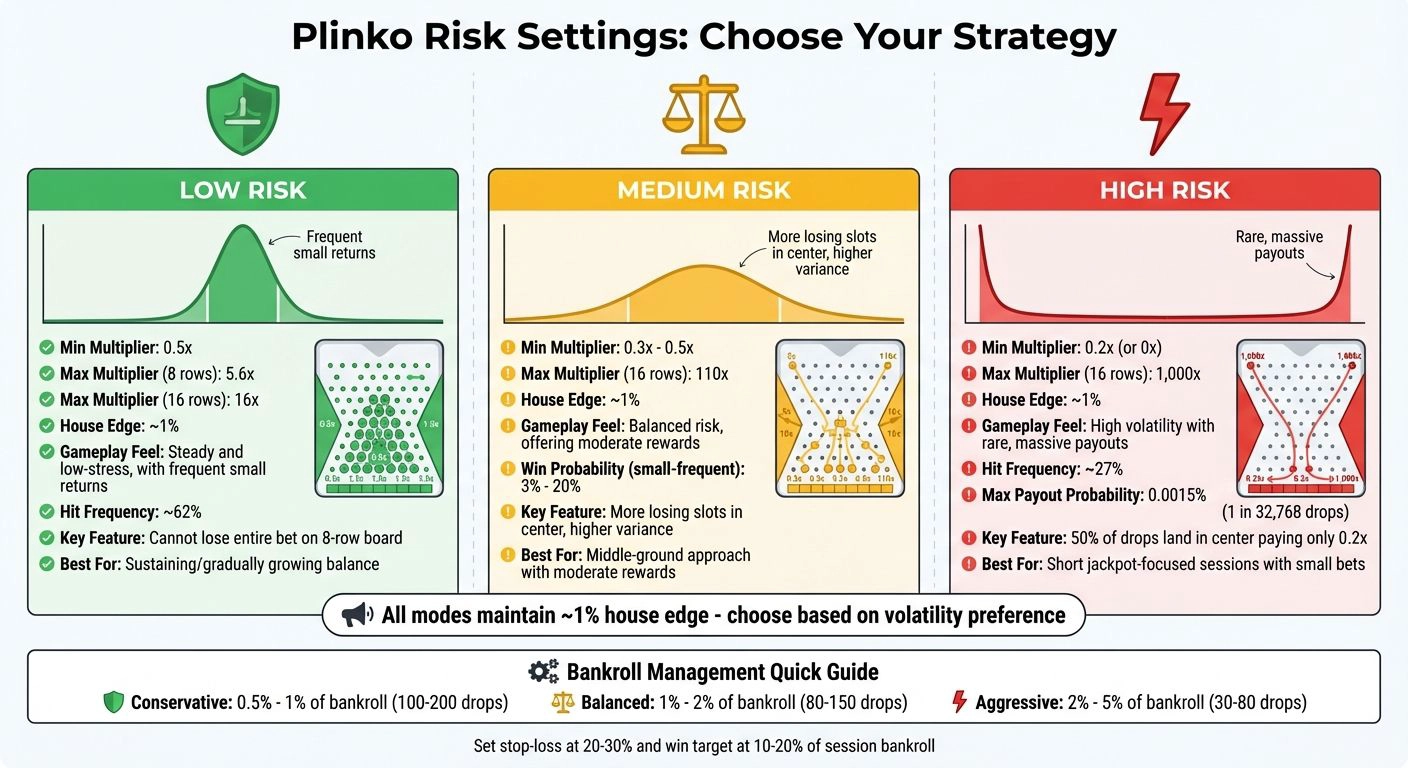
Plinko Risk Levels Comparison: Low vs Medium vs High Risk Modes
In Plinko, the risk level you choose determines the multiplier distribution, not the game's physics. This means your decision hinges on whether you prefer steady, smaller returns or are willing to take a shot at rare, high-paying jackpots. As GamblingCalc explains:
"The risk level changes the multiplier distribution, not the physics."
Interestingly, most crypto Plinko games maintain a house edge of about 1%, regardless of the risk mode you select. This consistency means your choice should align with your bankroll size and your comfort level with volatility. Let’s break down how each risk mode impacts payouts and gameplay.
Low-Risk Mode
Low-risk mode is designed to protect your bankroll. Multipliers are concentrated near the center, so most drops return a significant portion of your bet. For example, on an 8-row board, payouts range from 0.5x at the lowest to 5.6x at the edges. With a 16-row board, the maximum multiplier climbs to 16x.
In this mode, losing your entire bet is not possible on an 8-row board. Using low-risk settings on an 8-row board with TrustDice Plinko, the team started with 30.854 TXT and bet 2 TXT per drop over 100 rounds. They ended with 35.454 TXT, earning a profit of +4.6 TXT and achieving an actual RTP of 102.48%. This demonstrates how low-risk mode can provide consistent small returns, making it ideal for sustaining or gradually growing your balance.
Medium-Risk Mode
Medium-risk mode strikes a balance between safety and reward. Here, the center multipliers are slightly reduced (often between 0.3x and 0.5x), but edge payouts become more enticing. On a 16-row board, the maximum multiplier can soar to 110x.
This mode introduces more "losing" slots (multipliers below 1x) in the center, leading to higher variance than low-risk mode. However, it also gives you a better chance at securing mid-tier wins without the extreme unpredictability of high-risk play. Typically, the odds of landing small, frequent wins in medium-risk mode range from 3% to 20%. If you're looking for a middle-ground approach that balances moderate rewards with some level of bankroll protection, this mode fits the bill.
High-Risk Mode
High-risk mode is all about chasing massive payouts, but it comes with significant challenges. Center slots can pay as little as 0.2x - or even 0x in some versions - while edge slots on a 16-row board can reach up to 1,000x. However, the probability of hitting the maximum payout is just 0.0015% (roughly 1 in 32,768 drops). As Plinko Games Online puts it:
"High risk carries the lowest probability of success, yet if luck is on your side, the payouts can be substantial."
In this mode, about 50% of your drops will land in center or near-center slots, which often pay only 0.2x. This can lead to long losing streaks, making high-risk mode best suited for short, jackpot-focused sessions using small, disposable bets. It’s not ideal for building a bankroll and requires strict limits and disciplined play.
Here’s a quick comparison of the three risk levels:
| Risk Level | Min Multiplier | Max Multiplier (16 Rows) | Gameplay Feel |
|---|---|---|---|
| Low | 0.5x | 16x | Steady and low-stress, with frequent small returns |
| Medium | 0.3x | 110x | Balanced risk, offering moderate rewards |
| High | 0.2x (or 0x) | 1,000x | High volatility with rare, massive payouts |
Each mode offers a distinct experience, so understanding these differences can help you tailor your strategy to match your goals and risk tolerance.
Bankroll Management Basics
Managing your bankroll is just as important as choosing the right risk mode. Even the safest strategy can drain your funds if you don’t carefully control how much you wager and how you allocate your money.
Set a Fixed Budget
Before you start playing, decide on a fixed budget - and think of it as an entertainment expense, not an investment. Break this total budget into smaller chunks for individual sessions rather than risking everything at once. For example, if you have $500 set aside for Plinko, divide it into five $100 sessions. Within each session, set a hard stop-loss (usually 20% to 30% of that session’s funds) and a win target (like 10% to 20% profit). This way, you’ll know when to stop.
For instance, if you begin a session with $100 and lose $20 to $30, it’s time to step away. Similarly, if you make a $10 to $20 profit, lock in your winnings and call it a day. This method helps you avoid the temptation of chasing losses or playing until you "feel lucky."
Don't Chase Losses
Chasing losses is one of the fastest ways to burn through your bankroll. In Plinko, where outcomes are entirely random, increasing your bets after a loss (like in the Martingale strategy) doesn’t work. Losing streaks can quickly wipe out your funds or hit table limits before you recover.
Casino expert Nick Kaloyanov advises using auto-play features to prevent emotional decisions:
"If the board goes ice-cold, it [auto-play] yanks the parking brake before I can tilt-bet."
Set your auto-play to stop automatically once you reach your loss limit. This removes emotion from your gameplay and prevents high-risk bets during a losing streak. Remember, there’s no hidden pattern to exploit - upping your stakes during a bad run is based on the gambler’s fallacy, not actual probability.
Spread Your Bets Across Multiple Drops
One of the smartest ways to manage risk is by placing many small bets instead of a few large ones. Aim for 100 to 200 drops per session by keeping each bet between 0.5% and 2% of your session budget. For example, with $100 set aside for a session, you’d bet about $0.50 per drop if you’re planning 200 drops. This approach gives you more time to play and allows the game’s return-to-player balance to even out over a larger sample size. Plus, it minimizes the stress of watching big bets disappear.
Siddharth Rao highlights this approach:
"Smaller bets buy you time and reduce emotional tilt."
Here’s a quick guide to help you decide on bet sizes based on your playing style:
| Player Profile | Bet Size (% of Bankroll) | Target Session Length |
|---|---|---|
| Conservative | 0.5% – 1% | 100–200 drops |
| Balanced | 1% – 2% | 80–150 drops |
| Aggressive | 2% – 5% | 30–80 drops |
Bet Sizing and Betting Strategies
Once your bankroll is set, the next step is figuring out how to size your bets for the best results. By dividing your bankroll into sessions, you can determine how much to wager per bet. Your bet size plays a big role in how long you can play and how much risk you're taking on. The right strategy depends on your goals and experience level.
Start with Moderate Bets
If you're just getting started with Plinko, stick to flat betting. This means keeping your bet size consistent throughout the session - no sudden increases or risky decisions. A good rule of thumb is to bet 1% to 2% of your session bankroll per drop. For example, with a $100 session bankroll, your bets would range from $1 to $2. This approach gives you 80 to 150 drops, allowing you to get a feel for the game without risking everything upfront. As casino expert Nick Kaloyanov advises:
Small, steady bets go further than a few all-in Hail Marys.
Once you’re comfortable, you can experiment with progressive betting strategies when you hit profit milestones.
Progressive Betting Methods
Progressive strategies like Martingale and Fibonacci are common in many casino games, but they come with risks, especially in Plinko. The Martingale system, where you double your bet after every loss, can quickly recover losses if you win. However, a long losing streak can cause your bets to spiral out of control, potentially exceeding the game’s maximum bet or your bankroll. The Fibonacci method is slightly less risky - it follows a sequence (1, 1, 2, 3, 5, 8…) and steps back two units after a win. While these strategies can be tempting, they’re best reserved for controlled, low-risk situations with strict caps on your maximum bet.
A safer option is the "step-up" method. Instead of increasing bets after losses, you only raise your stake after hitting a profit target. For instance, if you start with $1 bets and your bankroll grows by $10, you could increase your bet to $1.20. This approach keeps risk in check while staying aligned with your session limits.
If your goal is to play for longer under high variance, consider focusing on smaller bets.
Use Small Bets to Play Longer
Smaller bets are key to managing variance and extending your playtime. In Plinko’s high-risk mode - where multipliers can reach 1,000× but occur less than 0.5% of the time - it’s smart to lower your bet size to handle the long stretches between big wins. Even aggressive players should limit their bets to 0.5% to 1.5% of their bankroll per drop when chasing these rare payouts. By keeping bets small, you can stretch your playtime and better manage the ups and downs of high-variance gameplay.
Analyzing and Adjusting Your Approach
Keeping tabs on your Plinko sessions is key to spotting effective strategies and avoiding unnecessary losses. Make it a habit to log not just your results, but also your emotional state during each session. These notes can help you identify psychological triggers that might lead to poor decisions. If you notice repeated patterns - like chasing losses - consider taking a 15-minute break after three consecutive losses. Use this information to refine your approach for future sessions.
Keep Track of Your Results
Start with something simple, like a spreadsheet or a notebook, to log your sessions. For every session, jot down your starting bankroll, the risk level, row settings, bet size, number of drops, and whether you ended up ahead or behind. Aim to track at least 20–30 drops per session to get a clear picture of short-term trends. After about 10 sessions, review your data to see which configurations helped maintain your bankroll and which led to impulsive decisions. Regularly analyzing your logs ensures your adjustments align with your overall risk management plan.
Adjust for Different Board Setups
Each board configuration calls for a different strategy. High-risk boards with 16 rows, for instance, offer thousands of possible paths and multipliers as high as 1,000×, but the center slots often return just 0.2× or nothing. For these setups, consider lowering your bet size to around 0.5%–1% of your bankroll to handle the inevitable dry spells between big wins. On the other hand, low-risk boards tend to deliver steadier, smaller payouts, making them perfect for longer sessions or testing new bet sizes. When tweaking your strategy, adjust only one variable at a time - like comparing 16 rows to 12 rows - while keeping other factors constant. This approach helps you identify what’s actually working. These small, deliberate changes build the foundation for a sustainable strategy, which ties into the long-term focus discussed next.
Think Long-Term
RTP (Return to Player) is a long-term metric based on thousands or even millions of drops, so it’s not something you’ll see reflected in a single session. In the short term, variance plays a big role - you’ll likely experience both hot streaks and cold streaks, regardless of your strategy. Professional gambler Alexei Volkov puts it this way:
Plinko mastery comes from embracing randomness while controlling what you can - your bet sizing, risk tolerance, and emotional discipline. The players who consistently win approach each drop with a strategy rather than hope.
Set clear boundaries before you begin. For example, establish a stop-loss at 20%–30% of your session bankroll and a win target at 10%–20% profit. Once you hit either limit, stop playing. This helps you avoid the trap of overplaying. Remember, Plinko outcomes follow a binomial distribution: while each drop is random, results tend to form predictable patterns over time. Your aim isn’t to outsmart randomness but to manage your bankroll through its natural highs and lows. The tracking and adjustments outlined here are essential for sticking to this long-term approach.
Conclusion
Managing risk in Plinko effectively comes down to understanding the game's settings, maintaining strict bankroll discipline, and making adjustments based on data. If you're playing in low-risk modes, you can expect a hit frequency of about 62%, which helps stretch your bankroll. On the other hand, high-risk modes, while offering tempting multipliers of up to 1,000×, only pay out around 27% of the time. Choosing the right mode depends on your comfort level with volatility, but keep in mind that these settings don't change the game's RTP, which typically ranges between 97% and 99%.
Before you start playing, set clear limits. A stop-loss at 20–30% of your session bankroll and a win target of 10–20% profit can help you stay in control. Betting just 1–2% of your total funds per drop also creates a cushion against the natural ups and downs of the game. When you hit your limits - whether it's a loss or a win - step away. Keeping track of your sessions, including your emotional state and the settings you used, can reveal patterns and help you avoid chasing losses. This kind of discipline is key to making the most of your Plinko sessions.
At the end of the day, Plinko is a game of chance. As casino expert Nick Kaloyanov explains:
Plinko is 100% luck-driven, once you drop the ball, you can't influence the outcome.
While you can't control where the ball lands, you can control your bets, risk levels, and overall approach. Treat your bankroll as an entertainment budget, not an investment, and always make sure you're wagering within your means.
FAQs
How do I pick the right Plinko risk mode for my bankroll?
Choosing the right Plinko risk mode depends on your budget, strategy, and overall goals. Here’s a quick breakdown to help you decide:
- Low-risk modes are perfect for cautious players or those working with a smaller bankroll. You’ll see frequent, smaller payouts, making it a safer option for those who prefer steady, consistent returns.
- Medium-risk modes strike a balance between reward and frequency. While wins are less frequent than in low-risk, the potential payouts are higher, appealing to those looking for a mix of excitement and stability.
- High-risk modes are for thrill-seekers chasing the biggest payouts. However, these come with much greater volatility, so be prepared for longer losing streaks.
Make sure your choice aligns with your comfort level when it comes to potential losses and always manage your bankroll wisely.
What’s the best stop-loss and win target for a Plinko session?
Managing your bankroll wisely is crucial when it comes to gambling. A good strategy for many players involves setting a stop-loss - often around 10-20% of their bankroll - to minimize losses. On the flip side, a win target is typically set at around 50% of the initial stake, helping players lock in profits. Deciding on these limits before you start playing is key to managing risks and avoiding heavy losses during unlucky streaks.
How many drops should I play before changing my strategy?
When playing Plinko, there’s no magic number of drops that signals it’s time to change your strategy - it’s all about chance. That said, dropping the ball 10-20 times can help you spot patterns and assess how your risk settings and bankroll are holding up. Jumping to a new strategy too soon might not give you enough data to make informed decisions. Instead, take your time, track your results, and tweak your approach only when it feels necessary to keep the game fun and engaging.